

Between Jerusalem and Athens
Faith, Reason, and the Byzantine Church as the Architecture of the Incarnate Logos

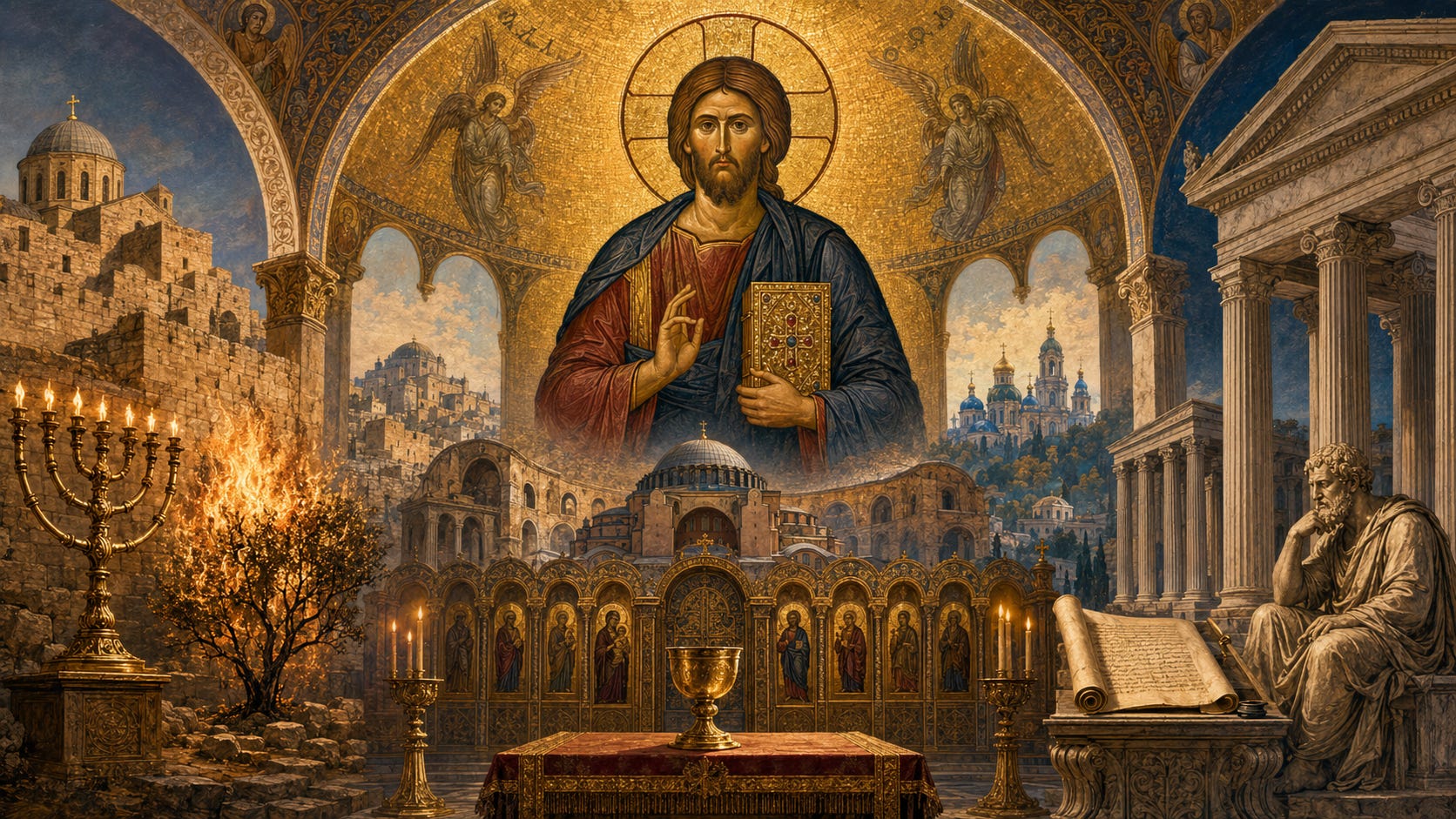
“I AM WHO I AM,” declares God.
“I am whatever you say I am,” replies modern man.
Between them stands the human person, wrestling with Being, identity, and the Logos.
A Logotecture, Logoelia, and Logoelitectura
Christian civilization was born from an encounter between two sacred cities.
Jerusalem asks what God has revealed. Athens asks what reason can know. Jerusalem hears the voice from the burning bush: “I AM WHO I AM.” Athens searches for the principle beneath change, the permanent order behind the restless surface of things.
Jerusalem gives us Abraham, Moses, the prophets, the Psalms, the Temple, the covenant, and the expectation of the Messiah. Athens gives us Socrates, Plato, Aristotle, metaphysics, logic, and the disciplined desire to understand what a thing truly is.
One city receives the Word as revelation. The other searches for the Logos as the intelligible order of reality.
Christianity brings both into the person of Jesus Christ.
The Incarnation is the hinge. The Byzantine Church is its sacred architecture. The Divine Liturgy of St. John Chrysostom is where Jerusalem and Athens cease to be competing abstractions and begin singing together.
Logotecture: The Architecture of Faith and Reason
Logotecture is the architecture of meaning through which revelation becomes tradition, words become worlds, and truth becomes a civilization capable of enduring.
Jerusalem and Athens are the two great pillars of Christian Logotecture.
Israel supplies the covenantal foundation. Creation is not an accidental collision of matter. God speaks it into being. History has direction because God acts within it. Human beings possess dignity because they are created in the image and likeness of God. Morality does not originate in appetite, empire, fashion, or majority opinion. It answers to the holiness of the Creator.
The God of Israel is not one being among other beings. He is not a larger or more powerful version of Zeus. He cannot be contained within nature, image, tribe, or philosophical category. He is the One who is.
This is the force contained within the name revealed to Moses:
“I AM WHO I AM.”
Before metaphysics became a formal discipline, Israel encountered Being as presence, freedom, holiness, and personal address. Moses did not deduce God from a syllogism. He encountered Him in fire.
Revelation does not make reason unnecessary. It establishes a world that reason can trust. If creation proceeds from divine Wisdom, then creation possesses intelligible order. The human mind can investigate reality because the world and the mind have their origin in the same divine Logos.
Athens developed the intellectual language needed to describe this order.
The pre-Socratic philosophers asked what remains constant beneath change. Parmenides confronted the mystery of Being. Heraclitus perceived a Logos ordering the apparent conflict of opposites. Socrates turned philosophy toward the examined life. Plato saw visible things as participating in realities greater than themselves. Aristotle developed the language of substance, form, causality, actuality, and potentiality.
Greek philosophy did not possess the fullness of biblical revelation. It fashioned a conceptual vessel capable of receiving it.
Israel carried the fire. Greece fashioned the lamp. The Church joined them and carried their light into the world.
Christianity did not simply borrow Greek philosophy, nor did revelation make philosophy irrelevant. The Church judged Greek thought, purified it, preserved what was true, and redirected it toward the living God.
The Fathers did not kneel before Plato. They made Plato answer to Christ. They did not mistake Aristotle for an apostle. They used the instruments of reason to defend the apostolic faith.
Reason possesses genuine dignity because truth cannot contradict truth. Faith that fears every question eventually slips into superstition. Reason that accepts only what it can manufacture eventually makes an idol of itself. The Byzantine synthesis refuses both errors.
Logoelia: The Living Voice of the Two Cities
Logoelia is the living breath within the architecture. It is the poetry, prayer, memory, proclamation, symbol, and song through which truth becomes inhabitable.
Jerusalem speaks through exodus and exile, lamentation and prophecy, genealogy and covenant. Israel remembers God through stories, festivals, psalms, sacrifices, and sacred time.
Athens speaks through dialogue, drama, epic, dialectic, and contemplation. Its philosophers seek clarity. Its poets disclose tragedy. Its artists search for proportion and form.
Athens wants to see the form. Jerusalem wants to hear the voice.
Christianity joins hearing and seeing because the invisible Word becomes visible flesh. The God whom no image could contain assumes a human face.
The commandment against idols remains, but matter itself is transformed by the Incarnation. The icon becomes possible because God has entered visibility without ceasing to be God. Christianity neither retreats into pure abstraction nor reduces God to an object. It proclaims that the uncreated God has entered creation so that creation may be transfigured by grace.
Byzantine Christianity speaks this truth in its native language.
Incense rises like Israel’s prayer before the Temple altar. Greek theological language guards the mystery of Christ. The Psalms are chanted. The Gospel is carried among the people. Icons surround the faithful like windows opening upon the communion of saints. The priest stands before the altar as the servant of a mystery he did not invent.
The dome declares heaven. The iconostasis preserves revelation and mystery. The candles confess that matter can bear divine light. Chant allows theology to breathe. The Eucharist completes the grammar as bread and wine become communion in the Body and Blood of Christ.
This is Logoelia in its fullest form. Language no longer speaks about God from a comfortable distance. Language becomes prayer, offering, encounter, and participation.
The Divine Liturgy does more than explain the Christian synthesis. It enacts it.
The Scriptures of Israel are proclaimed within a Greek theological world. Hebrew prophecy enters Byzantine hymnody. The priestly patterns of Temple worship are transfigured through the sacrifice of Christ. The philosophical term Logos ceases to mean only an impersonal order governing the cosmos. The Logos possesses a face.
He speaks. He suffers. He descends into death. He rises.
The opening of the Gospel of John is the decisive proclamation:
“In the beginning was the Logos, and the Logos was with God, and the Logos was God.”
John does not say that Jesus merely teaches the Logos. Christ is the Logos through whom all things were made.
The truth sought by Athens is the One proclaimed by Israel. Being has spoken. Wisdom has become flesh. Reason is no longer merely humanity’s ascent toward the divine. In Christ, divine Wisdom descends toward humanity.
The Fathers and the Baptism of Greek Thought
The Church Fathers stand at the meeting place of Israel and Athens. Their achievement was a transfiguration rather than a compromise.
St. Justin Martyr recognized seeds of the Logos within Greek philosophy while maintaining that their fullness belonged to Christ. St. Athanasius defended the divinity of the Son because salvation depends upon it. Only God can unite humanity to God. St. Basil the Great, St. Gregory the Theologian, and St. Gregory of Nyssa used Greek philosophical language while refusing to imprison God within Greek metaphysics.
Essence and energies, nature and person, being and communion were never merely intellectual puzzles. They protected the Christian understanding of salvation.
The councils required philosophical precision because confused language about Christ produces a distorted understanding of God and humanity. If Christ is not truly God, humanity is not truly united to God. If Christ is not truly human, human nature is not healed. If His divine and human natures are divided, confused, or diluted, the union between Creator and creation becomes unintelligible.
Doctrine has structural consequences. Theology is the load-bearing wall of Christian spiritual life.
The Fathers did not construct the truth. They built a conceptual architecture capable of guarding what the apostles had received.
St. John Chrysostom brought that architecture into worship and the public square. His theology did not float above ordinary suffering. It entered the streets of Antioch and Constantinople. He preached against greed, hypocrisy, indifference, and the abandonment of the poor. For Chrysostom, orthodoxy could never be separated from mercy. The altar within the church and Christ encountered in the poor belonged to the same spiritual reality.
The Divine Liturgy associated with his name embodies this integration. It is biblical without reducing Christianity to private interpretation of a text. It is philosophical without becoming rationalistic. It is mystical without abandoning reason. It is hierarchical without turning worship into domination. It is communal without dissolving the person into the crowd.
The Liturgy orders mind, body, memory, desire, and soul toward communion with God. It does not force a choice between thought and worship. It teaches us to think within worship and to worship in truth.
Theosis: The Purpose of the Christian Synthesis
The union of Jerusalem and Athens does not exist to produce a more impressive intellectual system. Christianity is not metaphysics decorated with candles.
Its purpose is theosis.
The goal of human existence is participation in the divine life by grace. God became man so that humanity might become godlike. This does not mean that human beings become divine by nature or disappear into the essence of God. Theosis is communion with God’s uncreated life while the distinction between Creator and creation remains.
Faith opens the person to revelation. Reason contemplates and articulates what has been received. Prayer purifies the heart. The sacraments incorporate the person into Christ. Asceticism trains desire. Love brings knowledge to fulfillment.
Theosis completes human nature rather than destroying it. Grace heals and glorifies the person. The saint becomes more fully human because sin is not our deepest identity. Sin is a corruption of our created freedom.
Athens asks what constitutes the good life. Jerusalem commands holiness. Christ reveals that the good life is communion with God and that holiness involves the transfiguration of the whole person.
Theosis surpasses both moral legalism and intellectual pride. Correct propositions matter because truth matters, but salvation is not the possession of a flawless theological vocabulary. Emotional intensity also has its place, but feeling alone cannot sustain spiritual life. The Christian path is a lifelong cooperation between divine grace and human freedom.
The mind must descend into the heart. The heart must be purified of fantasy and resentment. The body must become an instrument of prayer. The whole person must become transparent to the Logos.
Logoelitectura: The Byzantine Church as the Living Bridge
Logoelitectura is the bridge between the spoken Word and the structured world. It describes the passage through which revelation becomes civilization, symbol becomes sacrament, and truth becomes a way of life.
The Byzantine Church is not merely positioned geographically between Israel and Greece. It is the spiritual architecture in which their encounter becomes worship.
The Scriptures come from Israel. The theological vocabulary is refined through Greece. Constantinople gives the synthesis a historical and liturgical form. The Slavic peoples receive it through mission, translation, baptism, chant, icon, and monastery.
Kyivan Rus received Christianity from Constantinople. The waters of the Dnipro entered the same sacramental geography that began at the Jordan. The faith traveled north and took linguistic and cultural flesh among the people of Rus.
For a Ukrainian Byzantine Catholic, this inheritance is not theoretical. It lives in the Sign of the Cross made from right to left. It lives in the icons, prostrations, sung Creed, prayers before Communion, devotion to the Theotokos, and invocation of the Holy Trinity. It lives within a Church wounded by division while still carrying the memory of an older Christian unity.
My decision to become part of the Greek Orthodox community in my neighborhood is therefore more than a change of Sunday surroundings. I am encountering another expression of the same Byzantine inheritance. We share the same fundamental liturgical grammar, the Liturgy of St. John Chrysostom, the patristic atmosphere of the Christian East, and the understanding of salvation as theosis.
I am crossing a historical wound within the same Byzantine household.
The wound remains real. Catholics and Orthodox share apostolic succession, sacramental life, patristic theology, and most of the same liturgical inheritance, but we do not presently share full ecclesial communion. That reality should be treated with honesty. Genuine unity cannot be built through theological amnesia.
I can attend, pray, learn, form friendships, and speak openly with both the Greek Orthodox priest and my Ukrainian Catholic priest. Questions concerning Communion belong within that pastoral conversation because the chalice expresses the fullness of ecclesial unity.
Yet something beautiful is already possible.
I can enter the Greek Orthodox church as a son of the Kyivan Byzantine tradition meeting his Greek spiritual relatives. In their chant I hear the same river that flowed from Constantinople to Kyiv. They may pray in Greek and English while I carry Ukrainian prayers in my memory, but beneath those languages runs the same liturgical Logos.
This is not a shallow ecumenism that pretends our divisions have disappeared. It is a recognition of kinship grounded in prayer, truth, and hope.
Israel, Athens, Constantinople, and Kyiv
The spiritual geography is clear.
Jerusalem gives the covenant.
Athens gives the philosophical grammar.
Constantinople gives the liturgical synthesis.
Kyiv receives that inheritance, gives it local flesh, suffers for it, and carries it forward.
Yet none of these cities is the final center. Christ is the center.
Israel can be reduced to ethnic memory or legal code when separated from its fulfillment in Christ. Athens can become sterile abstraction or intellectual vanity. Byzantium can decay into aesthetic nostalgia, imperial fantasy, or nationalism wrapped in incense. Kyiv can also be tempted to confuse historical suffering with automatic righteousness.
Christ judges every city, nation, empire, and ideology. He fulfills every partial truth, yet He belongs to no political power.
The Church is holy because Christ remains faithful within her sacramental life, not because Christians have always behaved nobly. Her history contains saints and sinners, martyrs and courtiers, hesychasts and bureaucrats. The gold of the icon does not conceal the darkness of history. It declares that darkness will not have the final word.
This is why Byzantine Christianity matters in the modern world.
We live within a civilization saturated with information and starved of wisdom. We possess networks without communion, speech without silence, technical power without spiritual discipline, and choices without a clear purpose.
The Byzantine Church remembers that truth must be embodied.
She gives us a calendar as well as an argument, a sacred meal as well as a text, repentance as well as moral teaching, and a people as well as private inspiration. At the center she gives us the God-man.
Her answer to modernity is neither blind rejection of reason nor a sentimental retreat into the past. It is the recovery of right order: technology beneath wisdom, power beneath love, reason beneath the Logos, and the human person open to theosis.
The Cathedral of the Logos
Israel and Athens carried truths that Christianity could not abandon.
Israel knew that God speaks. Athens knew that truth can be sought. Christianity proclaimed that the One who speaks is also the Truth whom reason seeks.
The Byzantine Church built a cathedral around this revelation. Its architecture consists of Scripture, dogma, icon, hymn, sacrament, fasting, mercy, and prayer. Within that cathedral, faith does not fear reason, and reason does not place faith on trial. Both kneel before the incarnate Logos.
This is Logotecture: the durable architecture of covenant, metaphysics, doctrine, and worship.
This is Logoelia: the living river of prophecy, philosophy, chant, icon, and sacred memory.
This is Logoelitectura: the bridge through which Israel’s revelation and Athens’ reason become communion in Christ.
This is also where my own path now stands.
I enter the Greek Orthodox church as a Ukrainian Byzantine Catholic carrying Kyiv’s reception of Constantinople, Constantinople’s reception of the Fathers, the Fathers’ encounter with Athens, and the apostles’ inheritance from Israel.
I do not arrive empty-handed. I carry within myself the memory of a wounded communion.
I hear familiar petitions. I recognize the incense. I make the ancient Sign of the Cross. I encounter the Chrysostomic architecture of praise. Across the fractures of history, the Liturgy remembers a unity that division has obscured but never entirely destroyed.
The Church still sings. The Logos still speaks. The fire of Israel still burns within the lamp of Greece.
Beneath the Byzantine dome, surrounded by the saints, heaven bends toward earth as the faithful confess the mystery upon which the entire cathedral rests:
Jesus Christ is the incarnate Logos, the fulfillment of Israel, the Wisdom sought by Athens, and the living bridge through whom humanity enters communion with God.
Faith and reason meet in Him.
Greek and Ukrainian stand before Him.
Truth becomes flesh.
Flesh becomes offering.
Humanity, through grace, becomes radiant with God.